
Clothes Warehouse
This is a sketch of the clothes warehouse, where prisoners would keep their work clothes and dress to get ready to go to the mine.The warehouse had cotton fur costumes, rubber boots, puttees, miner’s caps, etc.
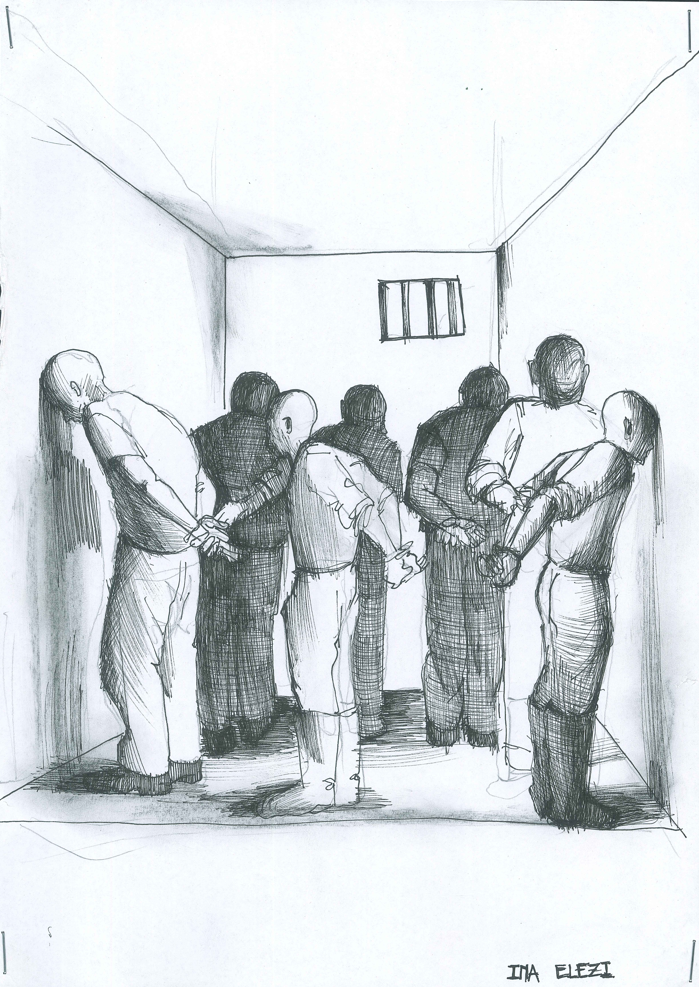
In certain periods, when discipline in the camp was exerted more aggressively and prisoners revolted more, violence and punishments also increased. In these cases, when several prisoners were punished at once, up to six or seven prisoners were put together in a single cell, who considering the very confined space of these cells, could not even sit or straighten their feet on the ground.
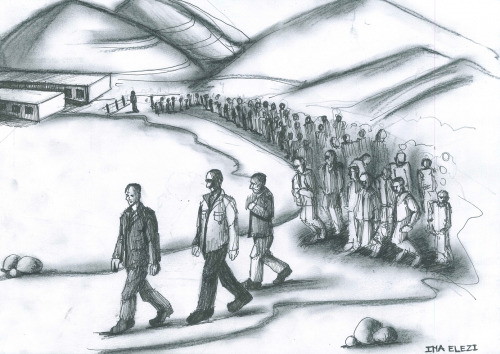
Departure to the mine for the first shift began at 6:30, after a head count was done by police at the camp’s exit gate, somewhere next to the sleeping area, where prisoners would line up, often irregularly, and meandered down to the mine areas where their brigade was assigned.Brigades were divided according to the intake of camp prisoners.In certain periods during Spaç Camp’s operation, there were 50 prisoners per brigades; sometimes the number would reach 65 prisoners.They would follow the path to the tunnel’s entrance where they were assigned.
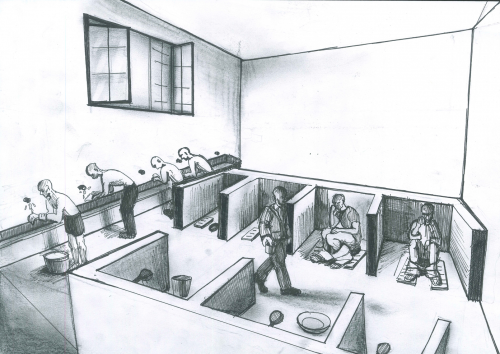
The toilet was the first place prisoners went to after waking up. After leaving the sleepig area, prisoners all went to do their morning routine. In the first years of the camp’s operation, the toilet was a large rectangular barracks, where sheet metal and boards served as walls, and the roof was made of eternit. Its inner space was like in this sketch.The bathrooms were in one side, which were open and doorless, completely removing everyone’s right to intimacy.The only separation was a low one-meter wall separating the spaces between them.Within the space of a toilet, there was simply a hole where they relieved themselves and some cement around to put their feet on.
Meeting the rates was often impossible. Few prisoners could physically handle that titanic load at work. In many cases during the cave-ins in the tunnel, there was not enough mineral to fill seven wagons. But prison command never accepted any justification for not meeting the rate. The most common expression of officers in Spaç was “Either your plan (target) or your soul”, which implied that death awaited all those who didn’t give the regime whatever was required at all costs.
At Spaç Camp there was a store, a 4x4m building near the smith’s. Prisoners, referring to the seller’s name, called it Ndue’s store. The store was state-owned and the seller was a free man who came to the camp every day. In ShkëlqimAbazi’s testimony, it is indicated that “…in Spaç’s Revolt, political prisoners undertook not to touch the store, even if people would be starving. They guarded it to make sure nobody attacked it. So, it wasn’t touched.”
The store often sold food products like sugar, flour, rice, oil. There were also some stationeries, like pencils, pens, notebooks, envelopes, etc.
But how did prisoners buy when physical money was prohibited in camp? ShkëlqimAbazi explains in his testimony: “We had no money in the physical sense. We had imaginary money if we can call it that. Our money existed in the accountant’s office, who marked the money prisoners earned by work or those their families brought. Until 1972, the law in force dictated that no matter how much you worked, the most you can earn is 18 leks. The accountant noted the income collected for each prisoner. Before going to the store you placed the order at the accountant: e.g., he would order 1 kg of sugar, oil, pasta, for which he would get a coupon. He’d open the records and check: Shkëlqim has, let’s say, 1,000 leks. Deduct 500 leks, and 500 leks remain. If the balance didn’t match, you didn’t get a coupon. This was the money we used: the coupon.”
This is a sketch of the clothes warehouse, where prisoners would keep their work clothes and dress to get ready to go to the mine.The warehouse had cotton fur costumes, rubber boots, puttees, miner’s caps, etc.