
Punishment to the cell
Upon their return, rebel prisoners who refused to work were put in cells and left in isolation up to 30 days. In official records, we discover that only in the first half of 1980, 118 convicts had been put to the cell.
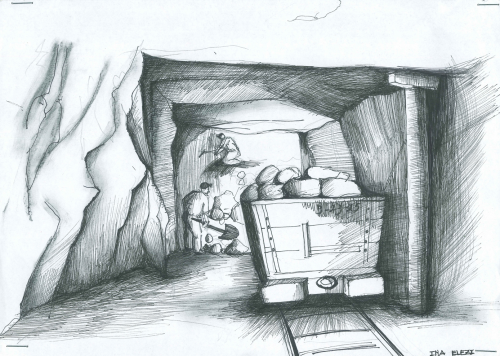
In the copper area the daily target was also seven wagons. Provided that one shovelful of copper weighed less than that of pyrite, work was somewhat less difficult in these areas. Furthermore, climate conditions in copper tunnels were more stable and there was no great temperature variation as in the pyrite area. According to the same estimate, the quantity a prisoner had to manually load onto the wagons every day to then transport them to the heap was 8,400 kilograms of copper.
The work routine was also the same in the copper area. At the start, they extracted mineral with wagons from the work front where the explosion had occurred, cleaned the inert material, and then reinforced the cleared front, create holes to detonate the explosives for the successive shift.
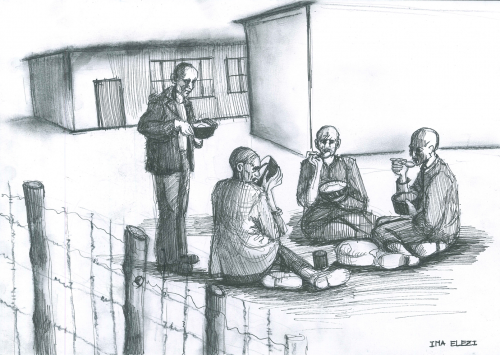
In the first years of the camp’s operation, prisoners ate wherever they could, as there was no dedicated area to eat in.According to Shkëlqim Abazi’s testimony, prisoners gathered in groups and consumed their food wherever they could in the areas near the barracks serving as a kitchen.
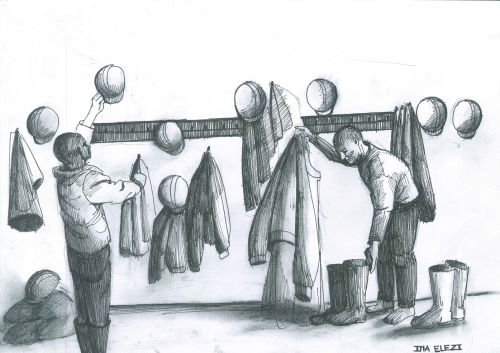
Prisoners in Spaç were also provided with prison clothing, which was used both during work and rest in the camp.The provision for each prisoner included:two cotton twill costumes a year, a brown fur coat (stuffed with cotton waste) once every three years, two pairs of long underpants and two stiff poplin shirts, which, as ex-prisoner Shkëlqim Abazi testifies, “that fabric rubbed on the skin like sandpaper”, two pairs of puttees (square pieces, the same material as shirts, with which they wrapped their feet before putting on their boots, when they went to the mine), a pair of rubber moccasins and a cloth hat like the puttees’ fabric.At the beginning of the ‘70s, a cotton twill fur costume was added, stuffed with cotton waste and sewn with seams to hold the cotton inside.This product was designed to better handle the cold in the mine, but it was very heavy and uncomfortable for the mine’s conditions, adding to the prisoners another form of suffering, as it would absorb the humidity during the eight hours in the mine, increasing manifold the miners’ weight by the time they exited.During winter they would not dry until the next day and were thus often a source of disease for prisoners.Prisoners were also provided with a cotton twill jacket thinly coated with resin that served as mackintosh.The uniform also had two pairs of gloves and wool socks and two pairs of rubber boots and a carton cap.The work clothes were held at the clothes warehouse in the camp.
This is a view of the prisoners’ cafeteria in the ‘70s.After performing their morning routine in the toilet, prisoners who started first shift would hurry to the cafeteria to have breakfast and go to work. At 6:00 am, all prisoners who’d work first shift had to have finished their breakfast and be ready to go to the tunnels.For the first shift that worked in the mines, breakfast was soup with seasonal vegetables and sometimes a little meat.But this menu did not apply to those working above ground or in supporting sectors, as they had a poorer diet and they never had meat.
After ending eight hours of forced labor, prisoners delivered their work tools and got ready to start their downwards walk to the camp entrance. At the camp entrance, all prisoners went through a daily check by guards as the latter feared that prisoners could be holding tools they took out of the tunnels to return in hiding to the camp. Another check was done if all prisoners were present or not, as it often happened during shift hours that prisoners who entered the tunnel would be able to find hidden exits and leave the camp’s enclosure and escape. Around two hours after finishing their shift and checks, prisoners went to the cafeteria to eat lunch and after exactly one hour go through roll call. Later, the command had free time to fill mainly through obligatory readings of the regime’s party propaganda. Afterwards there was dinner and at around nine in the evening, sleeping time started for the first shift.
Upon their return, rebel prisoners who refused to work were put in cells and left in isolation up to 30 days. In official records, we discover that only in the first half of 1980, 118 convicts had been put to the cell.